Pipeline examples (the infer “stat menu”)
This page follows the R infer
observed-statistic examples
vignette: the calculate(stat=...) forms organized by the types of variables
involved, using the same gss dataset (a sample from the US General Social
Survey) that ships with the package.
import moderndive as md
from moderndive import get_p_value, get_confidence_interval, assume

gss = md.load_gss()
gss.head()
| year | age | sex | college | partyid | hompop | hours | income | class | finrela | weight |
|---|---|---|---|---|---|---|---|---|---|---|
| i64 | i64 | str | str | str | i64 | i64 | str | str | str | f64 |
| 2014 | 36 | "male" | "degree" | "ind" | 3 | 50 | "$25000 or more" | "middle class" | "below average" | 0.896003 |
| 1994 | 34 | "female" | "no degree" | "rep" | 4 | 31 | "$20000 - 24999" | "working class" | "below average" | 1.0825 |
| 1998 | 24 | "male" | "degree" | "ind" | 1 | 40 | "$25000 or more" | "working class" | "below average" | 0.5501 |
| 1996 | 42 | "male" | "no degree" | "ind" | 4 | 40 | "$25000 or more" | "working class" | "above average" | 1.0864 |
| 1994 | 31 | "male" | "degree" | "rep" | 2 | 40 | "$25000 or more" | "middle class" | "above average" | 1.0825 |
Throughout, the pattern is the same as in R infer:
the observed statistic comes from
specify() → [hypothesize()] → calculate();a null distribution comes from adding
generate()beforecalculate();a bootstrap distribution (for confidence intervals) comes from
generate(type="bootstrap")with nohypothesize().
One numerical variable
# mean
gss.specify(response="hours").calculate(stat="mean")
ObservedStatistic(stat='mean', value=41.382)
# median, then standard deviation
print(gss.specify(response="hours").calculate(stat="median"))
print(gss.specify(response="hours").calculate(stat="sd"))
ObservedStatistic(stat='median', value=40)
ObservedStatistic(stat='sd', value=14.82)
Standardized mean (one-sample t) — needs a hypothesized mu:
gss.specify(response="hours").hypothesize(null="point", mu=40).calculate(stat="t")
ObservedStatistic(stat='t', value=2.08519)
A full one-mean test — null distribution and p-value:
obs_mean = gss.specify(response="hours").calculate(stat="mean")
null_mean = (
    gss.specify(response="hours")
    .hypothesize(null="point", mu=40)
    .generate(reps=1000, type="bootstrap", seed=1)
    .calculate(stat="mean")
)
get_p_value(null_mean, obs_stat=obs_mean, direction="two-sided")
| p_value |
|---|
| f64 |
| 0.03 |
…and a bootstrap confidence interval for the mean:
boot_mean = (
    gss.specify(response="hours")
    .generate(reps=1000, type="bootstrap", seed=1)
    .calculate(stat="mean")
)
get_confidence_interval(boot_mean, level=0.95, type="percentile")
| lower_ci | upper_ci |
|---|---|
| f64 | f64 |
| 40.12395 | 42.608 |
One categorical variable
# proportion of a "success" level, then the raw count
print(gss.specify(response="sex", success="female").calculate(stat="prop"))
print(gss.specify(response="sex", success="female").calculate(stat="count"))
ObservedStatistic(stat='prop', value=0.474)
ObservedStatistic(stat='count', value=237)
Standardized proportion (one-sample z) — needs a hypothesized p:
gss.specify(response="sex", success="female").hypothesize(null="point", p=0.5).calculate(stat="z")
ObservedStatistic(stat='z', value=-1.16276)
A one-proportion test by simulation (draw, alias simulate):
obs_prop = gss.specify(response="sex", success="female").calculate(stat="prop")
null_prop = (
    gss.specify(response="sex", success="female")
    .hypothesize(null="point", p=0.5)
    .generate(reps=1000, type="draw", seed=1)
    .calculate(stat="prop")
)
get_p_value(null_prop, obs_stat=obs_prop, direction="two-sided")
| p_value |
|---|
| f64 |
| 0.286 |
One categorical variable (3+ levels): chi-square goodness-of-fit
Test whether the counts across a variable’s levels match a set of hypothesized
proportions. Pass p as a {level: probability} mapping to
hypothesize(null="point", ...), then generate(type="draw") to simulate from
those proportions:
levels = gss["finrela"].unique().to_list()
uniform = {level: 1 / len(levels) for level in levels}  # "all classes equally likely"

obs_gof = gss.specify(response="finrela").hypothesize(null="point", p=uniform).calculate(stat="Chisq")
null_gof = (
    gss.specify(response="finrela")
    .hypothesize(null="point", p=uniform)
    .generate(reps=1000, type="draw", seed=1)
    .calculate(stat="Chisq")
)
get_p_value(null_gof, obs_stat=obs_gof, direction="greater")
| p_value |
|---|
| f64 |
| 0.0 |
The one-line wrapper is chisq_test(gss, response="finrela", p=uniform).
Two categorical variables (2 levels each)
# difference in proportions of "degree" between the sexes
gss.specify(formula="college ~ sex", success="degree").calculate(
    stat="diff in props", order=("male", "female")
)
ObservedStatistic(stat='diff in props', value=-0.00420337)
# ratio of proportions and the odds ratio
spec = gss.specify(formula="college ~ sex", success="degree")
print(spec.calculate(stat="ratio of props", order=("male", "female")))
print(spec.calculate(stat="odds ratio", order=("male", "female")))
ObservedStatistic(stat='ratio of props', value=0.987998)
ObservedStatistic(stat='odds ratio', value=0.981648)
Standardized difference in proportions (z):
gss.specify(formula="college ~ sex", success="degree").calculate(
    stat="z", order=("male", "female")
)
ObservedStatistic(stat='z', value=-0.098526)
Two categorical variables (chi-square test of independence)
obs_chisq = gss.specify(formula="finrela ~ sex").calculate(stat="Chisq")
obs_chisq
ObservedStatistic(stat='Chisq', value=9.1054)
null_chisq = (
    gss.specify(formula="finrela ~ sex")
    .hypothesize(null="independence")
    .generate(reps=1000, type="permute", seed=1)
    .calculate(stat="Chisq")
)
get_p_value(null_chisq, obs_stat=obs_chisq, direction="greater")
| p_value |
|---|
| f64 |
| 0.1 |
A chi-square test is inherently one-sided; the theoretical distribution agrees:
n_levels_finrela = gss["finrela"].n_unique()
df_chisq = (n_levels_finrela - 1) * (gss["sex"].n_unique() - 1)
assume("Chisq", df=df_chisq).get_p_value(obs_chisq, direction="greater")
| p_value |
|---|
| f64 |
| 0.104933 |
One numerical and one categorical variable (2 levels)
# difference in mean age by college degree
gss.specify(formula="age ~ college").calculate(
    stat="diff in means", order=("degree", "no degree")
)
ObservedStatistic(stat='diff in means', value=0.94066)
# difference in medians, ratio of means, and the two-sample t
spec = gss.specify(formula="age ~ college")
print(spec.calculate(stat="diff in medians", order=("degree", "no degree")))
print(spec.calculate(stat="ratio of means", order=("degree", "no degree")))
print(spec.calculate(stat="t", order=("degree", "no degree")))
ObservedStatistic(stat='diff in medians', value=3)
ObservedStatistic(stat='ratio of means', value=1.02355)
ObservedStatistic(stat='t', value=0.802379)
Null distribution and p-value for the difference in means:
obs_diff = gss.specify(formula="age ~ college").calculate(
    stat="diff in means", order=("degree", "no degree")
)
null_diff = (
    gss.specify(formula="age ~ college")
    .hypothesize(null="independence")
    .generate(reps=1000, type="permute", seed=1)
    .calculate(stat="diff in means", order=("degree", "no degree"))
)
get_p_value(null_diff, obs_stat=obs_diff, direction="two-sided")
| p_value |
|---|
| f64 |
| 0.44 |
One numerical and one categorical variable (3+ levels): ANOVA F
gss.specify(formula="age ~ partyid").calculate(stat="F")
ObservedStatistic(stat='F', value=2.48421)
Two numerical variables
# Pearson correlation, then the regression slope
print(gss.specify(formula="hours ~ age").calculate(stat="correlation"))
print(gss.specify(formula="hours ~ age").calculate(stat="slope"))
ObservedStatistic(stat='correlation', value=0.00701719)
ObservedStatistic(stat='slope', value=0.00780766)
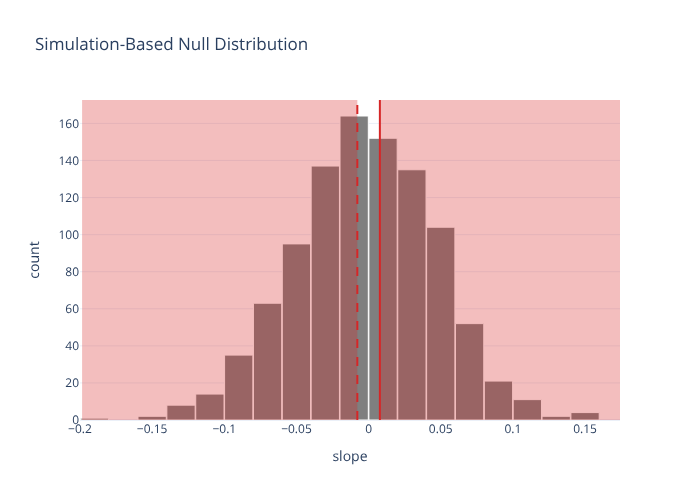
A permutation test for the slope, visualized:
from moderndive import visualize, shade_p_value

obs_slope = gss.specify(formula="hours ~ age").calculate(stat="slope")
null_slope = (
    gss.specify(formula="hours ~ age")
    .hypothesize(null="independence")
    .generate(reps=1000, type="permute", seed=1)
    .calculate(stat="slope")
)
visualize(null_slope) + shade_p_value(obs_stat=obs_slope, direction="two-sided")
Custom statistics
Any of the above can be swapped for a callable returning a single number — see the custom-statistic example in Hypothesis testing.